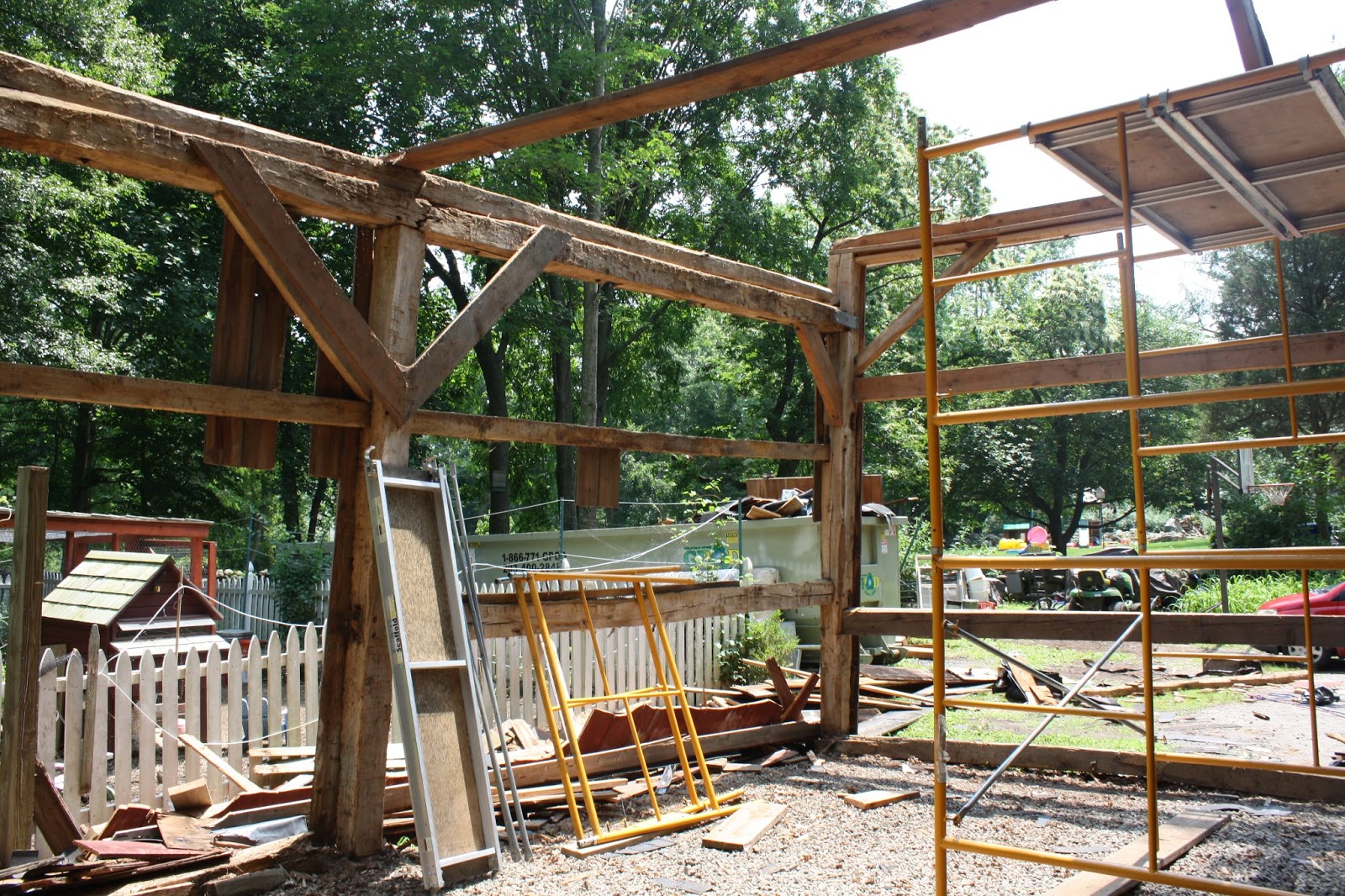
At last! Restoration work on the Enos Kellogg Barn is finally under way.
While we had been able to nurse our much-neglected 18th century barn along since purchasing the property in 2001, a chance meeting with a giant white pine tree during Super Storm Sandy last October left us with the choice of either undertaking a major restoration project or risking the collapse of the structure.
 |
| Front View, Pre-Restoration |
 |
| Back View, Pre-Restoration |


While simple economics might have argued for the latter course of action, we simply couldn't stomach the thought of seeing the old barn give up the ghost on our watch. So, with some advice from the Connecticut Trust for Historic Preservation (which runs an amazing barn preservation program), we set out last fall to find someone to bring our barn back to life. Trying to juggle finding the right person to do the work, negotiating with our insurance company over the Sandy damage, applying for a barn stabilization grant, and scraping up enough of our own funds to get the project going was not particularly fun. Among the lowlights were having the first timber framer that we talked to flake out on the project right before it was scheduled to begin, and getting turned down for the barn grant due to a lack of funding for privately owned structures.
Happily, however, our barn mojo has improved dramatically in the past month. First, we caught an exceptionally lucky break when one of the timber framers that the CT Trust had recommended most highly had an unexpected opening in his schedule due to the postponement of another job. So, Renard Thompson and his crew (Lyla, Sam and Ben) were able to start work only a week after coming out to do a full evaluation of the structure in mid-June.

Renard is a walking encyclopedia of timber framing, having done beautiful restorations of many timber frame structures around Connecticut (take a look at his website - Bring Back Barns). In the two-and-a-half weeks that they have been on site, I have learned a ton about timber framing, in general, and our barn, in particular. Most interesting for me is confirmation that the barn is located on its original site (and not moved from somewhere else), and was constructed using tools and construction techniques consistent with the 1780s. So, in all probability, this barn is the original barn associated with our home, and it likely was built either concurrently with our house, or very shortly thereafter This makes its restoration all the more important in my eyes - we are extremely lucky to have both the original house and barn still standing as survivors after 230 years, and I see it as our duty to do what we can to help them endure for a few more centuries.
Our second lucky break came when we were trying find a source for white oak. Our barn was originally constructed almost entirely of this species of wood, which is ideal given its strength and rot resistance. Unfortunately, our project required quite a lot of new wood, most importantly to replace the rotted ground sills throughout the structure, and three particularly large pieces of oak to replace other posts and beams that were not salvageable. What I learned quickly is that big lengths of white oak are hard to find and are very expensive. Luckily, it occurred to me that our friend Clint Thorn might know of a good source. Clint is a master furniture maker, specializing in reproductions of some of the most beautiful pieces of furniture made in 18th century New England (check out his business The Open Talon). He harvests much of the wood for his projects right from his own farm. He, his wife, Kim, and their two sons live in Goshen, CT, on an idyllic farm that also houses their dairy operation (including cheese making and the crafting of amazingly delicious artisanal chocolates - check out their Thorncrest Farm & Dairy website). Unbeknownst to me, they also had started a wood mill on their farm, and what material did they have available? White oak! And for a very attractive price. As I said, our barn luck clearly had improved.


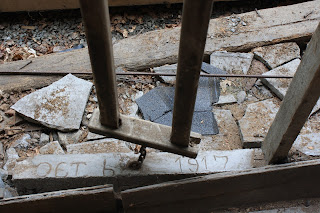


So, with a team of experienced timber framing experts and a source for wood, our restoration is moving along. So far, the crew has removed the majority of the roof, taken down the eastern bent of the barn where there was significant damage from the tree, poured new foundation piers for the eastern bay of the barn and prepared new sills and roof plates for that bay. They also have almost finished hewing a corner post for the northeast corner of the barn, which will replace the post that was broken by the falling tree. More details to come as the project progresses, but here are an array of photos of what has taken place so far.